
Best Practice Guide

The guide to choosing the right HR software
- You want to improve your HR management and are looking for the right software to support it.
- The range of HR solutions is huge, and vendors promise a lot. What exactly are the differences, and which HR software is really the best for your company?
- We want to help, so we put together this guide for your evaluation.
- It includes step-by-step instructions, field-tested templates, and checklists that ask the right questions in a sensible order and make sure nothing gets missed.
- We provide this approach so you can identify the best solution for your goals on your own terms, whether or not you end up choosing Hubdrive.
4144 | | | herausforderung

Best Practice evaluation in 10 steps
- Assemble the evaluation team
- Collect the improvements you want
- Take stock of your existing IT business platforms to capture added value
- Market research: HR software for your company
- Pinpoint potentially suitable HR vendors in a crowded market
- Have the most promising HR vendors present live
- Require proof of security and data privacy
- Make the different implementation strategies transparent
- Finalize the decision memo and any necessary additions
- Decide on the best HR solution for your company
4083 | HR | | best-practice

Step 1 of 10
Assemble the evaluation team
Assemble a cross-functional evaluation team early, with firm representation from HR, IT, and management.
- This covers functional, technical, and strategic requirements from the start.
- In larger companies, the works council and procurement belong on the team as well.
- Appoint a project lead who coordinates and documents decisions, and realistically free up their time for it.
The checklist guides you to a complete team that can make decisions, with clear roles and decision paths.
4093 | | | team

Step 2 of 10
Compile desired improvements
Together with your team, write down what should get better before you contact vendors. Think in goals instead of feature lists: less time and cost, more automation, security, flexibility, and convenience.
- Choose your areas: Where do you want to get better? If the list of areas gets too long, prioritize.
- Name the pain points: Where do you still work with paper or isolated IT silos? Where do manual work and handoffs between systems cost time every day, for example in personnel files or time tracking?
- Clarify transparency and integrations: Which reports are HR, managers, and leadership missing? Which systems, such as payroll, recruiting, or your website, should be connected?
- Factor in existing IT: A solution that fits into familiar tools such as Microsoft 365 or your ERP is adopted faster and builds on investments you have already made.
From these improvements, you derive your functional requirements. The checklist helps you collect and weight them in a structured way.
4092 | | | improvements

Step 3 of 10
Ask about your existing IT business platforms
Today, the leading HR solutions are largely comparable in core functionality. The platform makes the difference. What do we mean by that?
- Your company already runs business platforms, such as your ERP system or perhaps Microsoft 365, complete with a security concept, user roles, automations, and backups. An HR solution inside one of these platforms builds on the groundwork your IT team has already done.
- That way, your future HR solution is implemented up to 62% faster and reaches an up to 42% higher level of automation.
- Total costs can be up to 74% lower, and you avoid additional IT complexity from building and integrating yet another business platform.
With the checklist, you ask your IT team about its platform strategy in a structured way.
4091 | HR | | platform
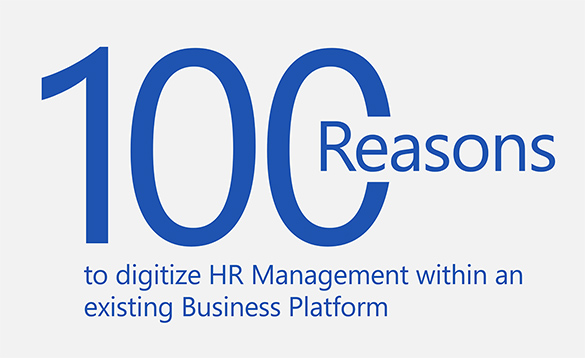
100 reasons to digitize HR Management within an existing Business Platform
In fact, there are 100 reasons why companies should digitize their HR management in one of their existing business platforms instead of in a classic HR system that stands apart as an IT silo. The reasons span every level and role in the company. Everyone benefits:
- The HR department spends far less time on daily work and gains more room to actively shape things.
- IT works with familiar technology instead of avoidable extra standalone solutions that need additional infrastructure.
- Employees enjoy more convenience by working in familiar apps and screens, with better integrated processes.
- Department heads handle their HR tasks where they already work, with no switching between systems and no IT silos.
- The CFO cuts costs through lower system and integration effort, more automation, and better use of existing licenses, which adds up to a faster ROI.
- The CEO gains strategic certainty by building on the innovative strength of the company's strategic business platforms, and the company is seen as an innovative employer as a result.
For customers with a Microsoft strategy, for example, the reasons can look like this.
Learn more
4181 | | | 100-reasons

Step 4 of 10
Market Research: HR software for your company
Use one of your established business platforms to implement your desired HR improvements faster, automate more processes, and reduce the overall workload for IT and business departments.
- In Step 3, your IT team listed your existing business platforms and identified which will remain in use long term and which will be phased out.
- Based on this information, research two to three HR solutions for the business platforms your company plans to use long term.
- Use online research, consult your AI assistant, and ask your colleagues in the IT department.
The following example illustrates the benefits:
Benefits of integrated working in the HR department
4090 | HR | | research

Step 5 of 10
Narrow down the selection safely and quickly
Rule out clearly unsuitable solutions with little effort. That leaves your time for the few vendors that really fit.
- Check exclusion criteria: For example, does the vendor support the country-specific requirements of every country you need?
- Compare functional areas: Do they cover the requirements derived from your improvement goals, or are there fundamental gaps?
4089 | HR | | vendors

Step 6 of 10
Have promising vendors present live
Ask each provider to demonstrate live in their solution how your improvement goals can be achieved.
- Preliminary discussion: Share your completed "Desired Improvements" form from Step 2 with the providers and explain your expectations.
- Live demo: The provider demonstrates your relevant processes and shows how your expected improvements will be achieved. Do not let standard presentations distract you from your goals. Use the feedback option in the form.
- Platform: The solution runs on the agreed platform, your employees recognize the familiar environment, and your IT team asks which extensions and configurations are required to operate it.
- Evaluation: Evaluate all providers against the same criteria, involving the entire team from HR, IT, management, and employee representatives.
For additional assurance, Walk-through videos and E-learning click-throughs are a good fit.
4088 | HR | | presentation

Step 7 of 10
Security and Data Privacy
Security and data privacy are deal-breakers: HR solutions on the market still do not fully meet legal requirements.
- Country by country: Have compliance demonstrated for every country where you will use the solution. What is compliant in Germany is not automatically compliant in Austria, Switzerland, or the United Kingdom.
- Ask specific questions: Where is our HR data stored? Who has access? How are permissions managed? What prevents employee data from flowing across national borders unchecked?
- Demand proof: Certificates and evidence from neutral sources, in writing, and for the platform as well. Solutions that are deeply integrated into an established platform already come with access control, encryption, and certifications.
- Involve your data protection officer early: Hardly any HR software can be retrofitted later. In the worst case, you face substantial fines.
Fill out the appropriate checklist yourself or send the link to vendors for self-disclosure. Keep the completed lists as evidence. The checklists are currently available in German.
Checklist: Germany Checklist: DACH (Germany, Austria, Switzerland)
Checklist: Europe incl. Switzerland Checklist: Europe incl. Switzerland and the UK
Checklist: Europe incl. Switzerland and the UK, plus the USA
4087 | HR | | security
Step 8 of 10
Make implementation strategies transparent
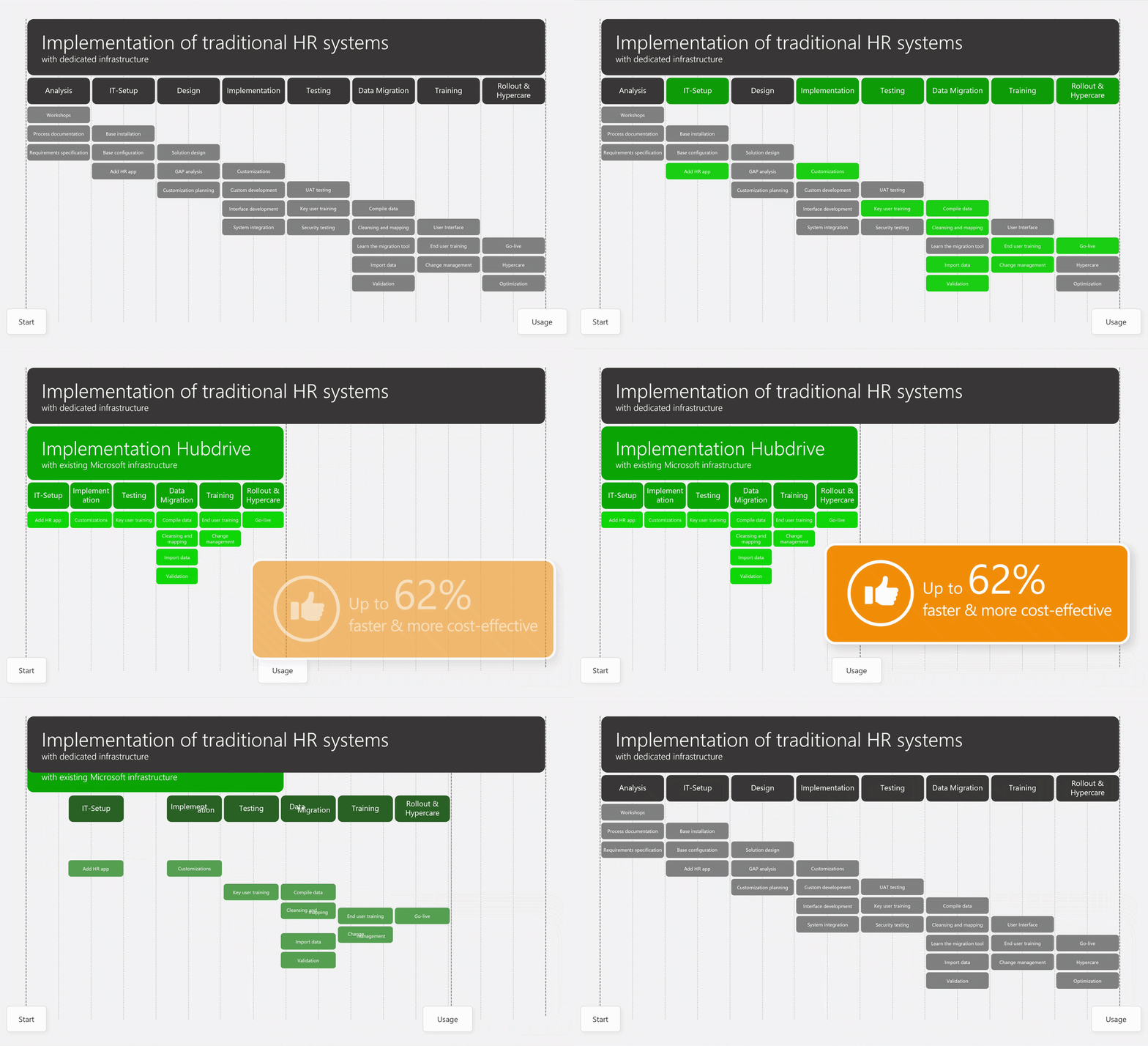
- Have the strategy explained: Every vendor or implementation partner lays out its approach, including a best practice approach and a fixed-price offer. Those unwilling to commit to a fixed price often lack experience with comparable projects.
- Implement according to best practice: This gets you up and running faster. Elaborate as-is analyses are usually unnecessary in HR, especially when the solution builds on your existing IT business platform.
- Stagger customizations: At the start, only what is really necessary. Everything else follows after initial use, when it is more concrete, less expensive, and comes with fewer change requests.
- In-house or with a partner: Clarify now whether you will implement on your own. Either way, a clearly documented, proven approach applies.
Example: Proven best practice implementation approach
4086 | HR | | implementation-strategies

Step 9 of 10
Finalize the decision memo and any necessary additions
- A good decision is not made in the final meeting. It is prepared throughout the entire evaluation process, which is exactly why HR, IT, and management should evaluate together from the start instead of only coming together at the end.
- Use a uniform scoring matrix that consistently reflects your defined improvement goals: less time spent on daily HR administration, a higher level of automation, lower total costs, more security, and more convenience for everyone involved, from employees to managers to IT.
- You should be able to present an ROI of just a few months for the decision if you manage to stay within one of your established business platforms. Your IT team then does not have to build new infrastructure. The existing environment is simply used more intensively. Implementing, operating, and adapting the HR solution costs less, and the ROI arrives sooner.
- Also ask the right questions about the partnership: Do you feel you are gaining a long-term partner, or that you are merely an order form someone can sell software to? Does the vendor provide a personal success manager who regularly discusses improvements with you? And do you have a direct line in an emergency?
- Finally, weigh the potential improvements against the total costs. If anything is unclear, ask the vendors for final clarifications. Use this to create a meaningful decision memo with evidence for the potential improvements and binding fixed-price costs for software and consulting.
- Present the decision memo, including evidence for the upcoming improvements and a recommendation, to your decision-making body, and prepare for questions.
4085 | HR | | decision-preperation

Step 10 of 10
Decide on the best HR solution for improvements in your company
The best HR solution for your company is the one that demonstrably meets or even exceeds your expected improvements. In closing, pay attention to the following perspectives:
- The implementation places little strain on your company because existing IT infrastructure is used and only slightly extended.
- A solid ROI of just a few months will demonstrably materialize, thanks to a high level of automation and little integration effort.
- Your employees readily adopt the new software because it builds on what is familiar and includes innovative elements such as AI or self-service, which is why you are seen as an innovative employer.
The total costs for licenses, implementation, training for IT and employees, ongoing maintenance, and extensions are low in relation to the improvements you are aiming for. Go through all of these perspectives once more with your decision-making body. One solution may already stand out, and you can make the right choice quickly and confidently. Large companies should then involve procurement and the works council one final time.
After all contracts are signed, we recommend starting the implementation within a few weeks. Use the momentum of enthusiasm in the evaluation team so that the first improvements reach your company quickly.
4084 | HR | | decision
Contact

Support for your evaluation
- The guide is designed so that you can use it on your own. We are happy to support you with our experience.
- If Hubdrive HR is among your potentially suitable solutions, we would be glad to be included in your selection.
- You are welcome to schedule a personal conversation here.
4111 | HR | | contact